

The telecom industry moves fast. But even by its own standards, the past five years have been extraordinary. Internet, entertainment, and communication services have been remade in the age of AI, and few companies have navigated that transformation as deliberately as Cox Communications.
Eric Pace, Cox's Head of AI, joined Pranay Agrawal, CEO of Fractal, on the Not Just AI podcast to trace that journey: where the company started, how it structured its AI practice, what has actually worked, and where the biggest opportunities and risks now lie.
What follows is not a story about technology. It's a story about decisions.
A career built at the customer's edge
Before Cox, there was Accenture, seventeen years of it. Eric Pace worked across business lines and industries, always close to the customer. That proximity shaped him. When he arrived at Cox, it wasn't just a change of employer. It was the chance to take everything he had learned about customer-centered design and apply it inside a single, complex enterprise.
That background informs one of Eric's most firmly held convictions: customer-facing AI applications require a higher standard of scrutiny. Every interaction a customer has with an AI system carries the company's reputation with it. Get it wrong, and trust erodes. The damage is harder to measure than a failed back-office process, but it's more lasting.
So Cox applies the same governance, training, and standards across both customer-facing and back-office AI systems. There is no tiered approach where internal tools are held to a lower standard. The commitment is consistent, or it is hollow.
A framework for what comes first
When Pranay Agrawal guides organizations through AI transformation, he starts with a question of architecture, not technical architecture, but organizational. Where do you build? Where do you grow? Where do you start?
His answer takes the form of three interconnected layers, each dependent on the ones beneath it.
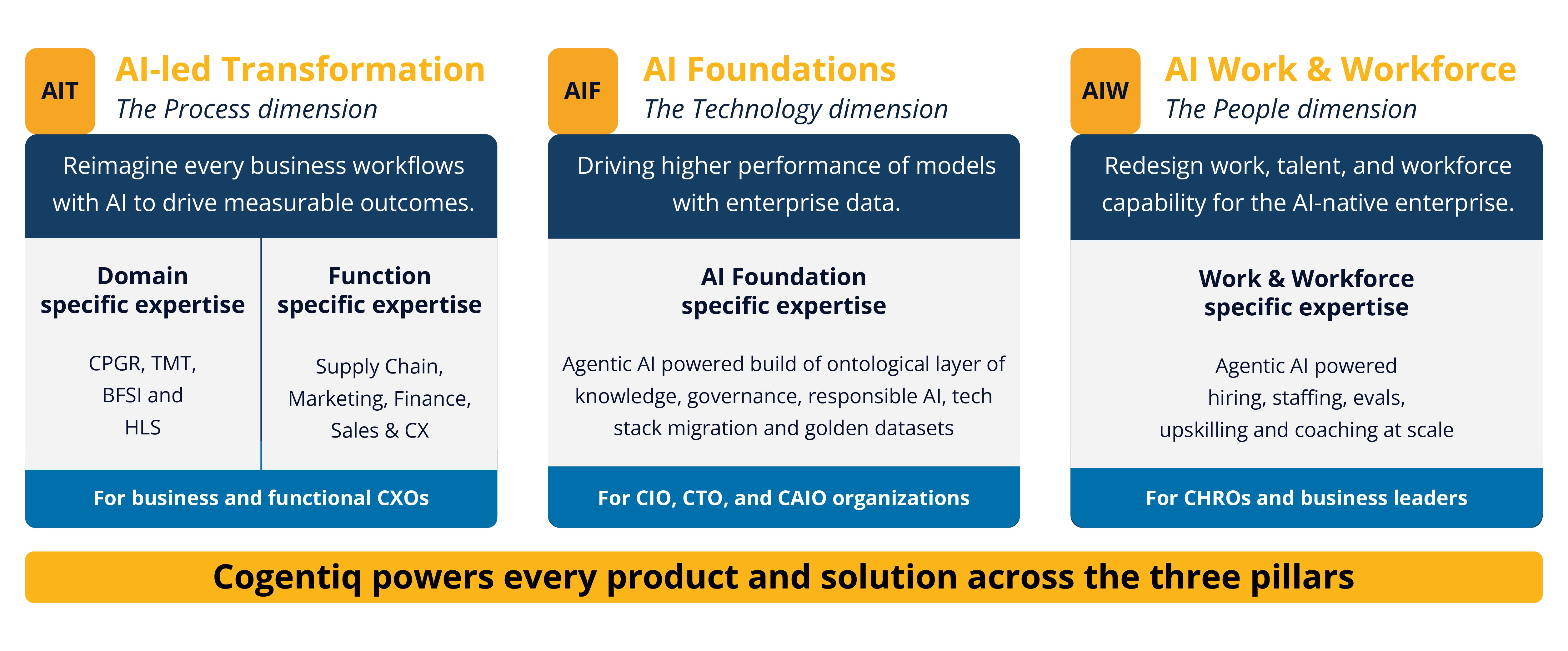
Eric Pace has seen this framework validated at Cox. The layers are not sequential steps to be completed and set aside. They are ongoing commitments that reinforce each other. Foundations enable transformation. Upskilling makes transformation stick.
The machine learning and generative AI combination
Beyond prediction into action
At Cox, AI is not a single system. It is a layered architecture. Traditional machine learning handles pattern recognition and probabilistic forecasting. Generative AI adds something machine learning cannot: context, reasoning, and language.
Eric illustrated this with a churn prediction example. Machine learning identifies customers who are likely to leave. But knowing that a customer has a 73% probability of churn is only the beginning. Generative AI steps in to interpret what's happening in that customer's life, a recent service interruption, an unresolved support ticket, a competitor offer they've been researching, and recommends a response tailored to that specific situation.
Machine learning surfaces probabilities. Generative AI helps decide what to do about them, sometimes autonomously.

Pranay Agrawal
Co-founder and Chief Executive Officer, Fractal Analytics
This combination is also reshaping Cox's network operations. AI helps identify root causes of outages, prioritize routing, rationalize tickets, and manage disruption events, producing some of the best service metrics the company has seen. Customer-facing channels, from chatbots to IVRs, are becoming more natural, more empathetic, and more context-aware.
And then there's Kami, a marketing tool that enables a small team to generate thousands of personalized emails and hundreds of white papers at a scale unimaginable just a few years ago. The workforce did not shrink. Its reach expanded.
Building a culture of disciplined execution
Speed without sprawl
Cox's AI success rate doesn't happen by accident. It's the result of a deliberate product mindset applied consistently across every initiative.
The company's CEO set the tone early: focus. Not a hundred experiments in parallel, but a smaller number of tightly scoped initiatives, each with clear definitions of what success looks like before development begins. Cox asks extensive questions upfront, not to slow things down, but to prevent building the wrong thing quickly.
Once an initiative clears that bar, the clock starts. One month to prototype. Two months to validate impact. No more than three months to reach production. The constraint is intentional: in a landscape where AI capabilities evolve as fast as they do, a product built over eighteen months may be obsolete by its launch date.
Eric is clear about what happens after launch. Version 1 is the goal. Enhancements beyond V1 are often not worth the complexity they introduce, unless they represent a genuine step-change in outcomes. Ship it. Learn from it. Move on.
Reporting follows a similar logic. The C-suite reviews AI progress every four to six weeks, focused on value creation and spend management. The board receives updates twice a year, calibrated to strategic priorities. Across the organization, AI teams share progress on an ongoing basis, not just upward, but laterally, creating a culture where AI outcomes are visible to everyone.
Governance that enables, not restricts
Of all the decisions Cox has made in its AI journey, the one Eric returns to most often may be the least glamorous: governance.
At most organizations, governance is a review process. At Cox, it's an infrastructure investment. The company has built monitoring and observability capabilities across its entire AI ecosystem, tracking inference calls, platform activity, logins, and usage patterns at scale.
The difference between governance as a barrier and governance as an enabler comes down to how you respond when something unexpected happens. Eric shared a telling example: an infrastructure engineer used Claude Code with Azure reporting data to automate performance monitoring tasks. It worked effectively. But the implementation bypassed some of Cox's standard runtime security and gateway monitoring because API calls were happening directly.
The governance team did not shut it down. They worked with the engineer to add the necessary visibility and controls so the solution could keep running safely. That response built trust in both directions.
Governance works best when it provides answers and safe pathways forward, instead of simply saying no.

Eric Pace
Head of AI, Cox Communications
The result is a paradox that actually holds: because Cox has put such strong guardrails in place, employees have more freedom to experiment, not less. The architecture earns the latitude.
The human side: From loop to helm
The technology questions, which models to use, how to build pipelines, and how to govern are real. But Eric spends significant energy on a different set of questions. How do you help someone who isn't a data scientist understand what AI can do for them? How do you make it feel approachable rather than threatening?
Cox invests heavily in workshops, resources, and one-on-one support. Practical exercises help, including something as simple as building an AI agent that recommends outfits based on a weather forecast. The technology is the same. The stakes are lower. Confidence grows.
But the bigger shift is conceptual.
The teams involved in Cox's most automated workflows, including B2B marketing operations, where AI agents handle significant parts of the process autonomously, are now among the most enthusiastic proponents of the technology. Not because their jobs disappeared, but because the most tedious parts of their jobs did.
They still set the direction. They still make the calls that matter. What's changed is the altitude from which they work.
The 'software-for-me' Era: Opportunity and risk
Eric is watching one trend more closely than any other: the democratization of software development. With tools like Claude Code, employees who are not traditional developers can now build their own AI-powered agents and applications. Everybody, as he puts it, is getting an everything maker.
His initial concern was something he called agent rationalization, the AI equivalent of the app rationalization problem that IT organizations spent years trying to solve, where thousands of redundant, overlapping applications accumulated in the enterprise. He expected the same pattern to emerge with AI agents.
That concern has evolved. The challenge isn't just the number of agents. It's that many people are building powerful tools without fully understanding the technical or governance implications of what they've created. New governance models will be required, ones designed not for a world where a dedicated IT team controls all software development, but for a world where everyone can build.
Everyone's got an everything maker and an everything doer. Enterprises need governance models built for that world.
Eric Pace
Head of AI, Cox Communications
This shift is also personal, in ways Eric finds worth sitting with. Highly specialized experts who once operated with a significant knowledge advantage over their peers are watching that gap narrow. As AI capabilities become more accessible, the expertise that once differentiated them becomes more widely distributed. It's not a comfortable transition, even for people who understand it intellectually.
The defining advantage
The conversation between Eric Pace and Pranay Agrawal circles back to a single idea: competitive advantage in the AI era does not come from building models. It comes from translating models into decisions, disciplined, scalable, measurable decisions that change what an organization can do.
Cox's approach is not complicated in theory. It is a focused product mindset, a rigorous governance framework, a commitment to upskilling, and a development philosophy built around speed and clarity of purpose. What makes it work in practice is the consistency with which it's applied.
The organizations that will define the next phase of AI adoption are those that have learned the same lesson Cox is living: adaptability isn't a strategic advantage. In this landscape, it's a prerequisite for relevance.